



TL;DR
Japan’s medical fee schedule is undergoing a significant revision effective today (June 1, 2026). This is the first major adjustment in 12 years, intended to combat inflation and staff shortages.
Patients will see modest increases in out-of-pocket costs for consultations and hospital meals. Meanwhile, healthcare facilities will receive new funding to improve wages and accelerate digital transformation (DX).
If you have regular medical needs, ask your clinic’s reception desk about price changes for your treatment plan.
What’s new
Beginning June 1, 2026, the Japanese government will implement a +3.09% base revision to medical fees to address rising operational costs and support wage increases for healthcare workers. This update introduces new surcharges for digital transformation (DX) and disaster preparedness, while slightly raising patient copayments for visits and hospital stays.
Why it matters
This reform is a delicate balancing act. It aims to keep Japan’s universal health insurance system sustainable for an aging society while ensuring that hospitals and clinics can afford the staff and technology needed for 2040 and beyond.
By the numbers
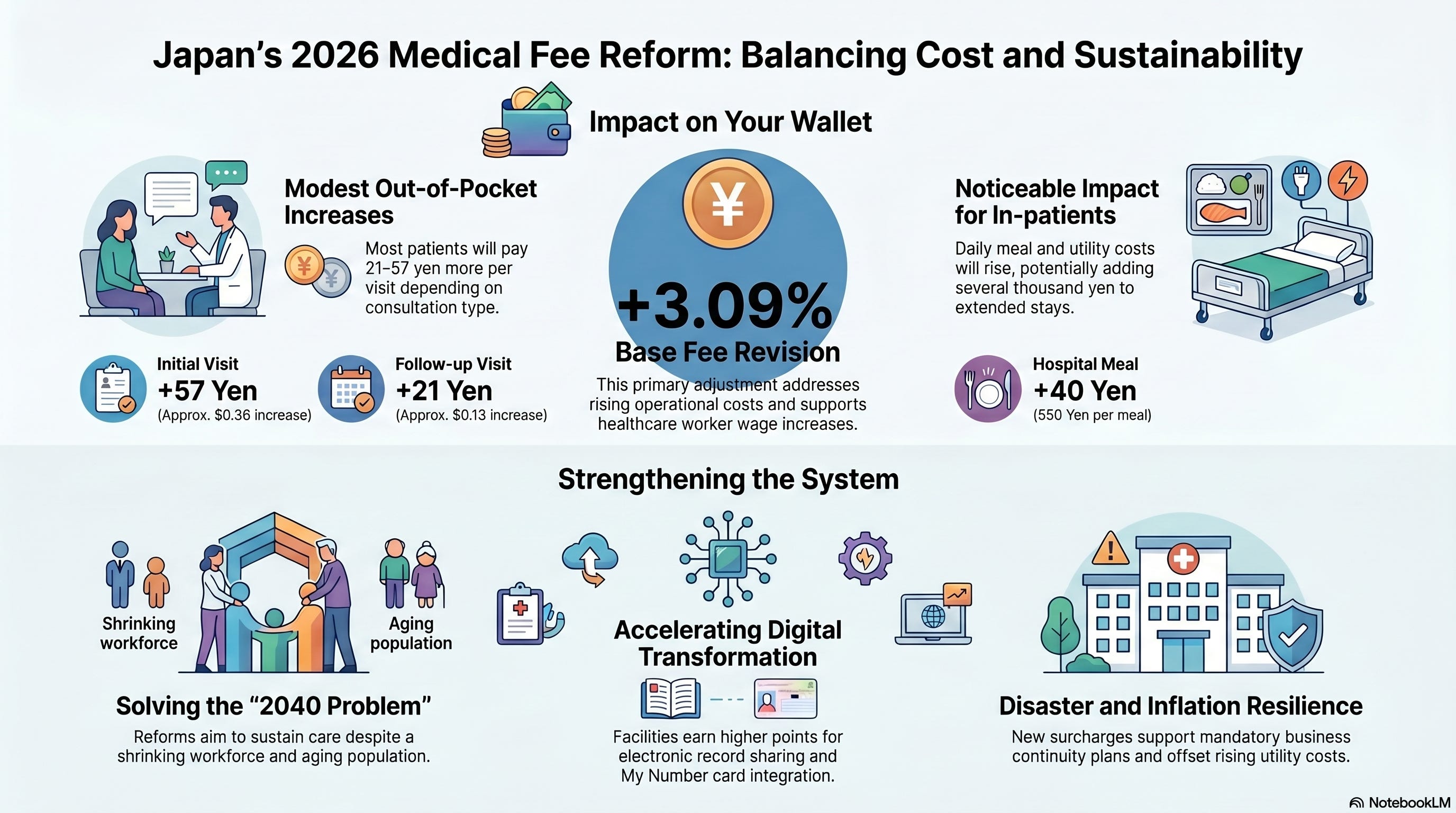
The base medical fee revision rate is set at +3.09%, the first significant positive revision in 12 years.
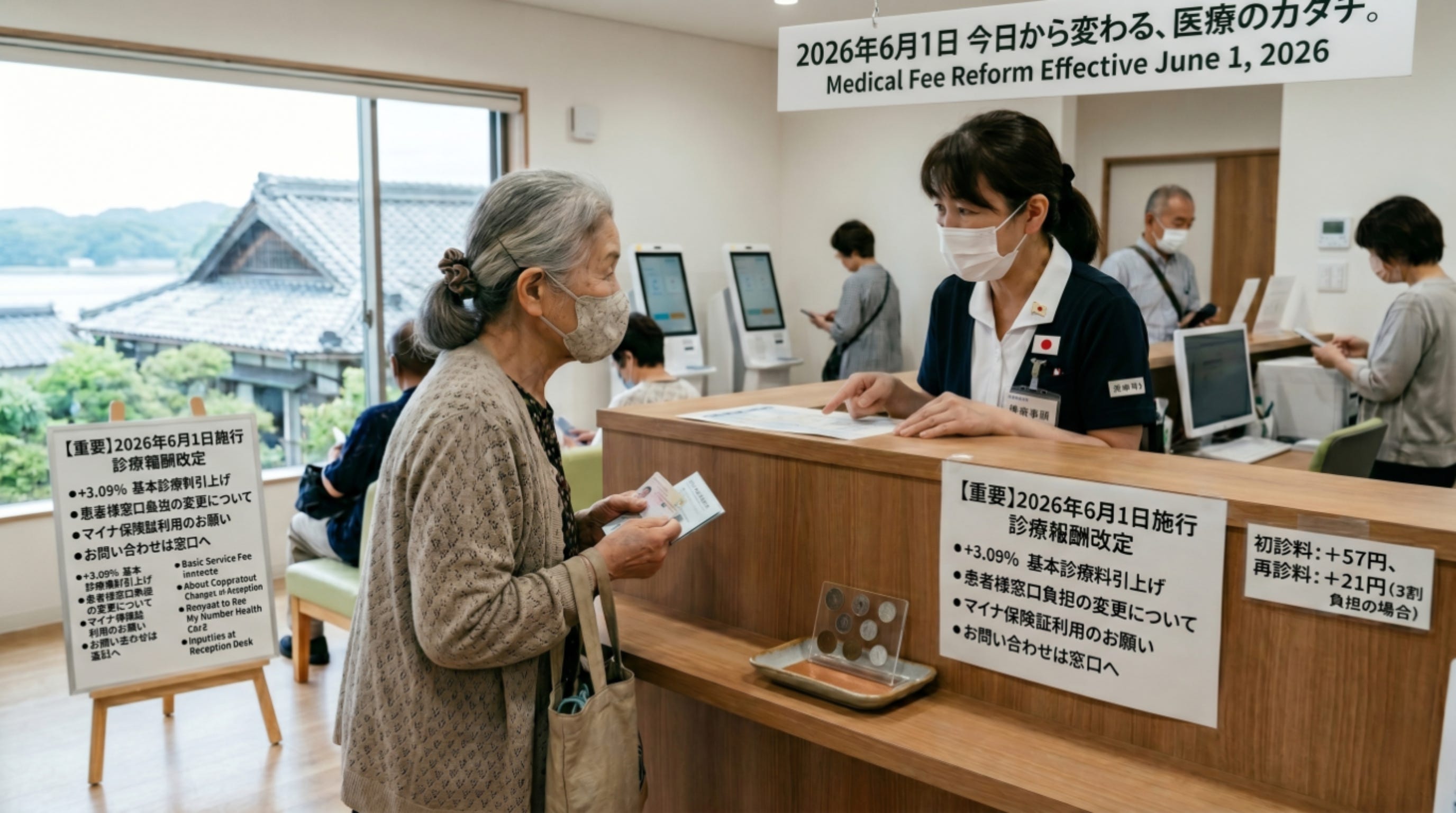
Patients with a 30% copayment will typically pay approximately 57 yen (US $0.36) more for an initial visit and 21 yen ($0.13) more for follow-up visits.
Hospital meal costs for general income earners will increase by 40 yen ($0.25) per meal, rising to 550 yen ($3.45).
For patients aged 65 and older in long-term care beds, daily utility costs will increase by 60 yen ($0.38), reaching 430 yen ($2.70).
Catch up quick
For over 30 years, Japan’s healthcare sector operated in a deflationary environment, keeping service prices static even as global inflation increased the cost of utilities, medical supplies, and wages. With labor shortages reaching critical levels and the population aging rapidly, the government changed its policies to ensure the viability of the healthcare workforce.
Context
The “2040 Problem” serves as the backdrop for these changes: a massive decline in the working-age population coupled with an explosion in the number of people aged 85 and older who require complex, coordinated care.
Conventional wisdom
It is widely believed that medical costs in Japan are fixed and universal. However, this revision highlights how costs fluctuate based on a facility’s registration, technology adoption, and disaster-readiness certifications.
That said, for a patient who visits an out-clinic once a month, this equates to an additional cost of roughly 300 to 600 yen per year ($1.88 to $3.76). This amount is statistically negligible for most middle-income households.
The impact is more pronounced for in-patients. An increase of 40 yen ($0.25) per meal, plus potential increases in utility costs for long-term care beds (an additional 60 yen ($0.38) per day), adds up more quickly during an extended stay. For a 10-day hospital stay, these adjustments would represent an additional financial burden of several thousand yen, which could be more noticeable for low-income households.
Go deeper
The revision introduces the “Acute Care Comprehensive System Surcharge” for regional hub hospitals and “Price Adjustment Fees” for hospitals and clinics to help offset record-high inflation in food and utility costs.
A major point of tension is the potential for “avoiding medical visits,” particularly among seniors who fear the cumulative impact of rising copayments. This concern is frequently cited by medical professionals and public policy experts.
Although a 50 yen ($0.38) increase seems minor, it occurs amid broader inflationary trends in Japan. Pairing rising medical costs with stagnant pension growth or rising costs of daily goods contributes to a sense of “living cost” anxiety. This anxiety is harder to quantify, but it is very real for vulnerable populations.
…but: Japan’s universal health insurance system includes several built-in safeguards that prevent modest increases from becoming catastrophic burdens.
One such safeguard is the High-Cost Medical Expense Benefit, which caps the total amount a patient pays for medical services in a single month based on their income. Even if a patient undergoes significant procedures, their out-of-pocket costs will not exceed their income-based limit.
Many Japanese municipalities provide extensive subsidies for medical expenses for children, single parents, and individuals with disabilities. In these cases, the local government often covers the out-of-pocket costs, meaning the recent national revisions may not impact the patient’s actual costs.
How it works
Facilities receive higher point allocations for adopting electronic medical record sharing, utilizing My Number health insurance cards, and proving their resilience through mandatory business continuity plans (BCPs).
Step back
This is not just about saving a few yen at checkout; it is a structural shift toward a community-based healthcare delivery system where acute care hospitals and primary care clinics have clearly defined roles to maximize limited resources.
Commentary
From an American perspective, these cost increases, which often amount to less than half the price of a can of Coke, can seem remarkably minimal compared to the volatility and high deductibles typical of U.S. private insurance. While any increase in out-of-pocket costs naturally faces public scrutiny, these periodic adjustments are necessary to maintain Japan’s universal, single-payer health insurance system. Japan has maintained universal coverage since 1961. For this system to remain sustainable against the dual pressures of global inflation and a rapidly aging society, price adjustments are essential safeguards, not just bureaucratic formalities. These adjustments ensure that the system can continue to provide high-quality care to all residents of the country without the crushing financial risks often associated with medical emergencies abroad.
It is highly likely that the latest revisions are a precursor to a broader “flat 30% copayment” model for all seniors, as the Ministry of Finance continues to advocate for “fair burden-sharing” in order to safeguard the disposable income of younger, working-age individuals.
What to watch
Keep an eye on March 2027, when new insurance limitations on over-the-counter (OTC)-like drugs, such as moisturizers and mild pain relievers, are expected to be implemented, further shifting the cost burden to patients.
The bottom line
For most working-age Japanese individuals, the 2026 revisions are not expected to pose a substantial financial obstacle to accessing healthcare. The system’s existing safety nets are still strong. The primary concern is not the cost of a single checkup but rather the cumulative effect of marginal cost increases on low-income seniors. There is also concern that these small changes might cause patients to deprioritize their health, creating larger systemic challenges in the future.
Links to Japanese Sources: https://news.yahoo.co.jp/articles/dc42b405a8ea027a7388ccfe7bb26c3b37d1ab93, https://www.solasto.co.jp/solastoonline/iryou/medicalfeerevision-2026/, https://www.medical-jpn.jp/hub/ja-jp/blog/medical-fee.html, and https://www.fnn.jp/articles/-/1038161.
#JapanHealthcare #MedicalReform #MedicalFeeRevision #HealthcareInnovation #HealthTech #JapanBusiness #PublicPolicy #HospitalManagement #診療報酬改定 #医療DX #病院経営 #2026年診療報酬改定 #ヘルスケア #日本医療 #社会保障 #RealGaijin #リアル外人
Please note that you can subscribe to Real Gaijin for free. If you are so inclined, you can also purchase an annual subscription for a relatively small fee.
However, I understand that even the lowest level of annual subscription allowed by Substack may seem too high for many. If you just want to buy a coffee for Real Gaijin (or maybe a green tea), you can also make a small donation here:

https://buymeacoffee.com/realgaijin
All levels of support - including just liking a particular article and/or leaving a comment - are very welcome. Thanks again for reading.
While Real Gaijin lives in Substack, you can also find Real Gaijin on a few other platforms (listed in alphabetical order).

https://www.instagram.com/real_gaijin_on_substack/

https://www.threads.net/@real_gaijin_on_substack

https://www.tiktok.com/@real.gaijin


https://www.youtube.com/@RealGaijin

After 10 years in Japan I realised that unless you are in emergency the medical system level is very rudimentary, there is no specialist navigator institution similar to GP. Basically as everywhere you need to “shop” for a good doctor , but in Japan it is much harder as the standards are different not focusing on prevention and active rehab but rather on removing symptoms and diagnoses like “age” and “genes” = good bye. This is probably revealed in the costs . I would rather pay more and have peace of mind.
Thinking about your recent articles on number of elderly who've turned to theft to keep themselves fed. Who covers medical care for the elderly who've been jailed(pre-trial) or imprisoned (convicted)? Are their savings confiscated or other assets, pensions, etc. effected?